Ramanujan Machine
I currently lead the Ramanujan Machine group under Professor Ido Kaminer, working on the intersection of AI and experimental mathematics. The field is changing very quickly: models, symbolic tools and automated search pipelines now let us explore mathematical spaces that were previously too large to investigate by hand.
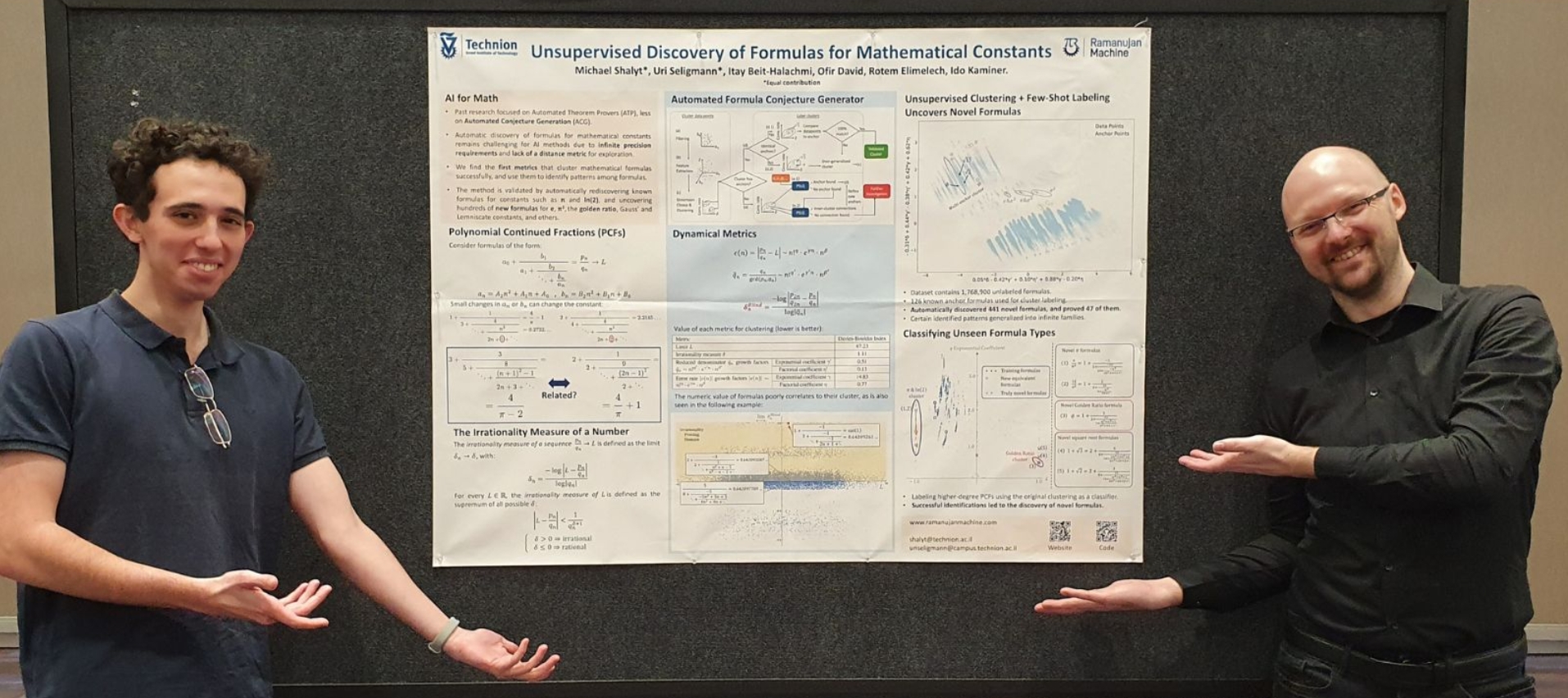
Our recent work includes the ASyMOB benchmark for algebraic symbolic reasoning, the From Euler to AI line on unifying formulas for mathematical constants, and the broader Ramanujan Machine effort to turn mathematical discovery into a scalable experimental process. Published outputs from this work include ASyMOB, From Euler to AI, the NeurIPS 2025 poster, the NeurIPS 2024 poster, and our PNAS paper.
One example of that direction is the work around conservative matrix fields and automated conjecture generation: combining AI with careful mathematical experimentation to surface structure, cluster families of formulas and suggest new paths for human insight. This short talk gives a quick taste of that line of work:
Evo.Do
Mid 2018 I left my role as CEO of Aperio Systems to start a new company: Evo.Do. We built autonomous AI-bots that tested and validated games, based on Reinforcement Learning algorithms.
It’s hard to make sure that a complicated game or app works properly after every change, patch, design shift etc. It takes thousands of tests and weeks of tester-time to do a full validation. For many years developers tried automating the process via scripting - programming a set of actions that should take the app from state A to state B and validate that indeed we reached state B. Unfortunately scripted tests are very “brittle” - any small change can make the test fail (not reach the intended end goal), even if there was no bug introduced. Devs ended up spending more time maintaining and fixing tests than fixing the actual game, and most went back to manual testing.
Evo strived to combine the best of both worlds: the speed and accuracy of test scripts with the adaptivity and flexibility of human testers. The user defines the goal of the test (for example “make sure the key can be picked up”) and the bot learns on its own (through trial and error) how to achieve that goal:
The novel approach (patent pending) garnered some interest and we were accepted to the inaugural batch of Tel Aviv University backed Xccelerator program, where I gave a pitch during the closing ceremony:
And later got into the largest startup accelerator in the world: Y Combinator (AI cohort).

Where I pitched at the famous YC demo day:
Going through YC was a life-goal of mine - so I got to strike that off the list as completed :).